


Qaike

Memory, Moats and What Vendors Still Add

Navy towers ringed by green and teal moats in front of grey storage cylinders and filing blocks, illustrating vendor memory and moats

Vendors of AI tools for funds compete on two fronts: with each other, and with the frontier labs whose models their products are built on. The labs now sell to financial firms directly, with general assistants that get better at the same tasks each quarter. Since July, Unique, Intapp, Hebbia and Metal have each put memory at the centre of their product: a lasting record of the user, the client, the firm and its methods.

The pitch is that the model forgets and the vendor remembers. This post looks at what “memory” means in practice and how each vendor builds it. It then asks a wider question: as general models improve, which vendor advantages last?

Four kinds of memory

“Memory” covers four different things. They differ in value, cost and risk.

KindWhat it holdsGain for the userCost or risk
User memoryYour role, style and current projectsNo repeated briefingEasy to copy: general assistants offer it too
Client and deal memoryThe history of each relationship or dealFaster preparation. Knowledge stays when staff leaveOld or wrong facts persist. Client data needs strict controls
Firm knowledgeFirm terms, entities and the links between them (its ontology, a formal map of how they relate)Fewer wrong answers on firm-specific questionsCostly to build and keep current. Hard to move
Procedural memoryHow the firm does a task: skills, playbooks, workflowsThe same standard of output across the teamLocks in today’s methods, sometimes in the vendor’s format

Figure 1 shows memory offerings from four vendors, set against a general assistant.
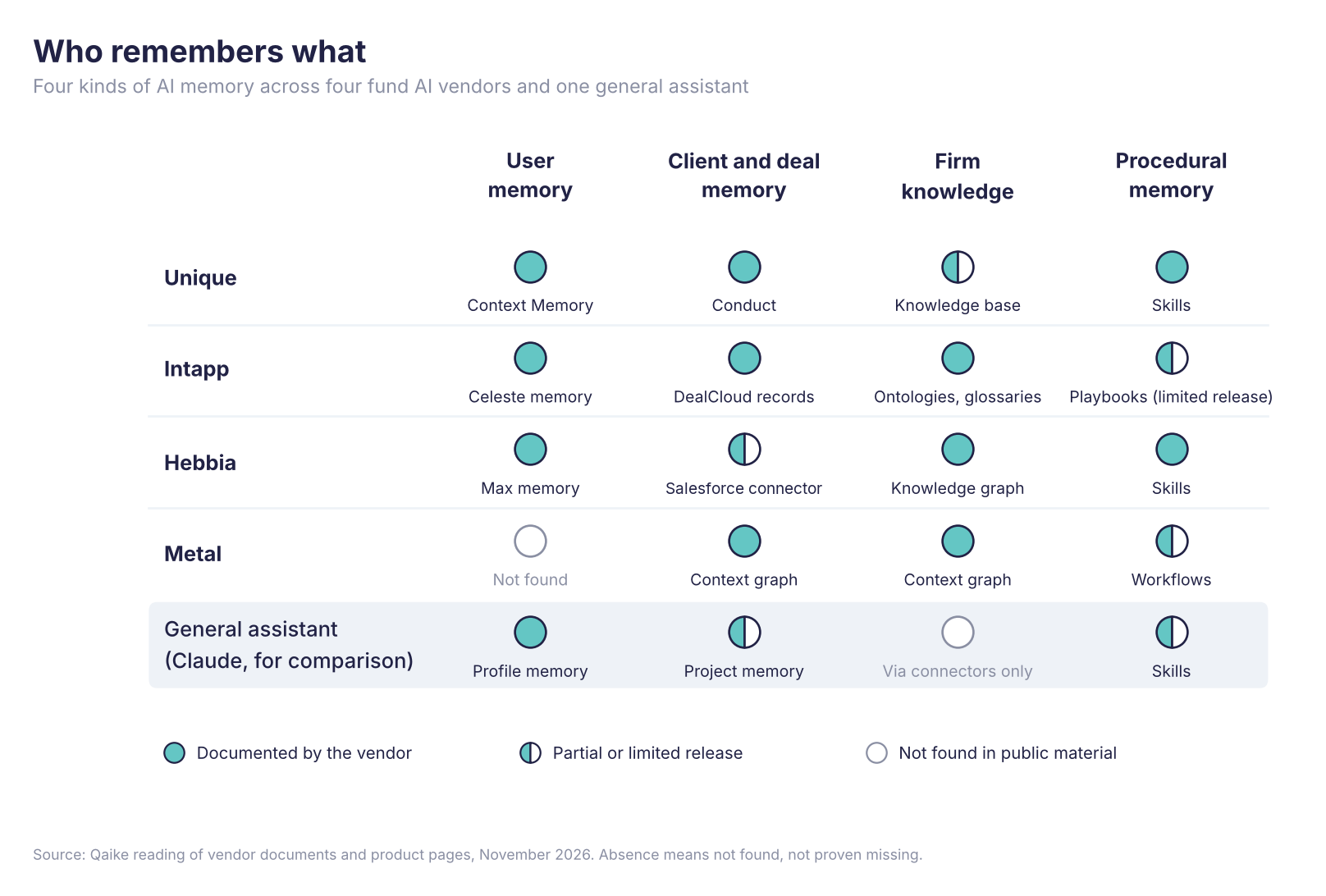
Matrix of four kinds of AI memory (user, client and deal, firm knowledge, procedural) across Unique, Intapp, Hebbia, Metal and a general assistant

Figure 1: Who remembers what. Source: Qaike reading of vendor documents, November 2026. Absence means not found, not proven missing.

Examples from four vendors

Unique: a file per user, with a filter

Unique is the most open about its design. Its Context Memory, launched in August, keeps one profile per user: a short structured text file with six fixed sections (identity, communication preferences, current work, skills, follow-ups and recent topics), capped at 2,000 tokens by default. After each answer a low-cost model call decides whether anything is worth saving. If so, a second call rewrites the profile and a third removes client-identifying data before it is stored.

Three details matter for a regulated firm:

  • The profile holds no client-identifying data. Work facts survive only in de-identified form.
  • Memory is off when web search is on. This keeps user data out of outside search queries.
  • Opting out does not delete the file. Unique’s own documents say the settings screen promises deletion and the system does not yet deliver it.

Client memory is a separate product. Conduct, launched in September, builds a running record of clients and past tasks inside a sandbox for each tenant, with permissions by role and a full audit log.

Our view: Strength: memory a compliance officer can inspect. Limit: opting out does not delete the file.

Intapp: the firm writes the dictionary

Intapp starts from its own CRM, DealCloud, where a firm keeps its deals, contacts and relationship history. Celeste, its agent layer, works on that data. On top sits what Intapp calls a semantic layer, where the firm builds and maintains its own ontologies and glossaries. A simpler “schema contract” tells Celeste which fields to read and write. Celeste also remembers a user’s patterns, decisions and preferences.

Two points stand out. First, Celeste applies the firm’s existing permissions and information barriers (also called ethical walls) to every answer. This matters more when an AI stores and recalls facts. Stored, linked facts can carry a restricted detail into an answer for someone not cleared to see it. A vendor that already runs a firm’s barriers has an edge here that a general assistant lacks.

Second, Intapp explains that the AI model is not the product: the DealCloud panel runs on Claude by default, the firm can change the model, and the firm’s playbooks stay put when it does. A playbook is a saved set of firm-specific instructions for a task, such as scoring a deal against the fund’s own investment criteria.

Our view: Strength: memory tied to the CRM and the information barriers a firm already trusts. Limit: much of the fuller version, including playbooks, is still in limited release.

Hebbia: a graph built from documents

Hebbia has added memory in three releases since July.

The first, in July, let firms share Skills, Hebbia’s procedural memory, across the organisation. Skills can be imported from other platforms, which suggests this kind of memory is becoming portable.

In October its assistant Max gained memory across conversations, with controls to create, review and delete what is kept. Administrators switch it on for the whole organisation.

In November it launched knowledge graphs. Each firm builds a record of how its documents and data relate: which names refer to the same legal entity, which contract terms a later amendment changed, which holdings link to a failed counterparty. Every link carries its source and its date, and access rules apply to each entity and link. Hebbia reports that in early tests answers using the graph cost 80% less than a leading frontier model working without one, and were more accurate. That is the vendor’s own test, and it has not published its method.

Our view: Strength: a graph that answers questions spanning many documents, such as exposure several steps removed. Limit: the 80% result is Hebbia’s own test, with no published method.

Metal: memory served to other AI tools

Metal does not need users to open its own app. It builds a context graph of a private equity firm’s companies, people, deals and decisions, then serves it, through a connector such as the Model Context Protocol (MCP), to whichever AI tool the team already uses. Workflows write their results back to the graph. The CRM stays the system of record.

Metal’s own app also runs on outside AI models. What changed is where people reach it, and Metal’s own figures show how fast. In February none of its customers had connected Metal to an outside assistant, such as Claude or ChatGPT. By October 78% of all interactions with Metal came through one. The two figures measure different things, customers connected and share of interactions, but both point the same way. Its benchmark scores the same model at 95.1 with Metal’s context and 86.6 with a file platform, out of 100, across 51 paired questions. As with the benchmarks we reviewed in October, the vendor sets the test.

Our view: Strength: firm memory that works inside any assistant. Limit: the benchmark is Metal’s own test.

Side by side

FeatureUniqueIntappHebbiaMetal
How memory is builtLearned from chats, then filteredCurated by the firm on top of CRM dataExtracted from documents and dataExtracted from deals, files and activity
Who controls itUser edits. Admin enablesFirm maintains. Existing permissions applyUser reviews and deletes. Admin enablesNot disclosed
DeletionOpt-out keeps the fileNot disclosedUser can deleteNot disclosed
ExportNot disclosedNot disclosedSkills can be imported. Export not disclosedFull export on request within 30 days. Also served to other tools through MCP
Model choiceSwappableSwappable. Claude by defaultSeveral frontier modelsModel-agnostic

“Not disclosed” means we found nothing in public material. It is the first thing to ask in a demo.

Memory among the moats

Memory is one of several ways a vendor can build an advantage. The others are familiar from our vendor landscape:

  • Licensed data, as with AlphaSense, Octus or Quartr.
  • Integrations and permissions, as with Intapp’s information barriers.
  • Compliance and audit trail, as with Greenboard.
  • Workflow and output format, as with Daloopa inside Excel.
  • Domain tuning and evaluation, as with Samaya or Rogo.

Two questions sort them. Who owns the raw material? And can a stronger general assistant replace the advantage? By stronger we mean the model and its harness: the tools, context handling and short and long-term memory that the labs now build around it. Figure 2 places each moat on those two questions.
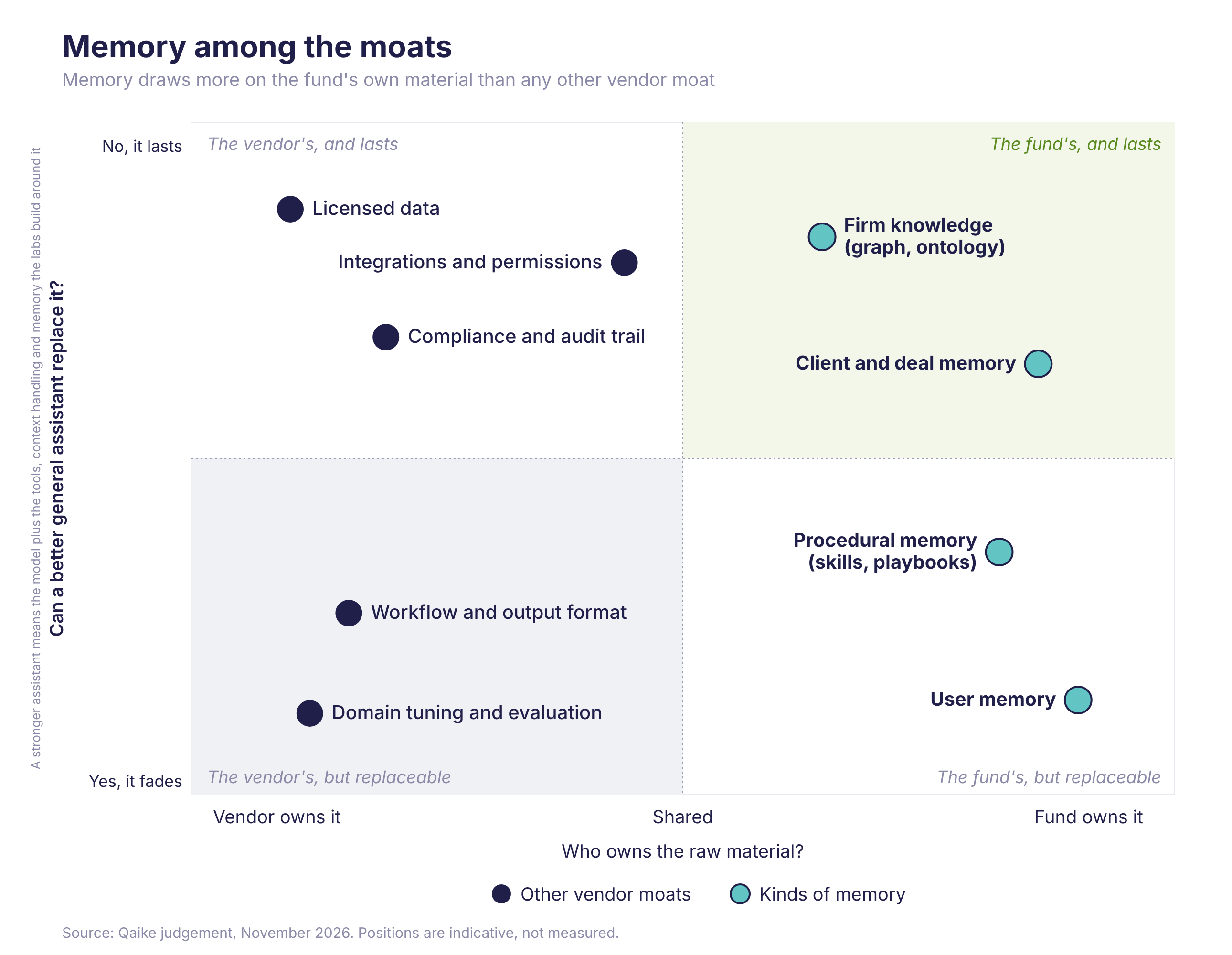
Quadrant chart placing vendor moats and kinds of memory by who owns the raw material and whether a better general assistant can replace them

Figure 2: Memory among the moats. Source: Qaike judgement. Positions are indicative, not measured.

Three things follow.

Memory draws more on the fund’s own material than any other vendor moat. Licensed data belongs to the vendor or its supplier. A tuned model belongs to the vendor. But a client history, a deal record and a firm’s methods belong to the fund. The vendor owns only the structure around them. Firm knowledge sits a little nearer the vendor than client and deal memory, because the vendor builds its entities and links from the fund’s documents. This makes memory an odd moat: strong while you stay, and open to dispute when you leave.

The four kinds of memory do not protect vendors equally. User memory is the most exposed. Anthropic’s enterprise plans already offer memory scoped to each project, which the user can view, edit, import and export. Procedural memory is next, since skills now move between platforms. Client and deal memory is more durable, because it is built from the fund’s own records, though it is only as good as the controls on stale or wrong facts. Firm knowledge is the most durable. Resolving entities, tracking amendments and enforcing access on every link is slow, specialist work, and a better model does not do it for you.

Memory works as a moat only when tied to something else. Unique ties it to compliance controls, Intapp to the CRM and information barriers, Hebbia to its document engine, Metal to distribution through other tools. Outside analysts reach a similar view: rent the model, own the data and the workflow integration. Vendors that offer workflow automation with no proprietary data are the most exposed to the frontier labs.

So what do vendors still add?

A year ago the answer might have been a better interface and prompts tuned for finance. Frontier models have absorbed much of that. What remains is narrower and more useful:

  • Structure. Turning a firm’s scattered files into entities, links and dated facts.
  • Control. Applying permissions, information barriers and audit to every answer.
  • Data rights. Licences to content the labs do not hold.
  • Accountability. A named party that a regulator, or an investor in a due diligence review, can question.

The vendors are also hedging on where their product appears. Intapp says its playbooks outlast any one model, and Celeste can run inside Microsoft Copilot. Hebbia offers its Matrix inside Claude and ChatGPT. Matrix is Hebbia’s spreadsheet-style workspace: documents form the rows, questions form the columns, and each cell holds an answer with its source. Metal goes furthest: it is built to be reached from other assistants rather than through its own screen. A “headless” vendor keeps its data and memory but gives up its own screen. Users reach it from inside a general assistant, such as Claude, ChatGPT or Copilot, through a connector such as MCP. Figure 3 sets out the three arrangements now on offer.
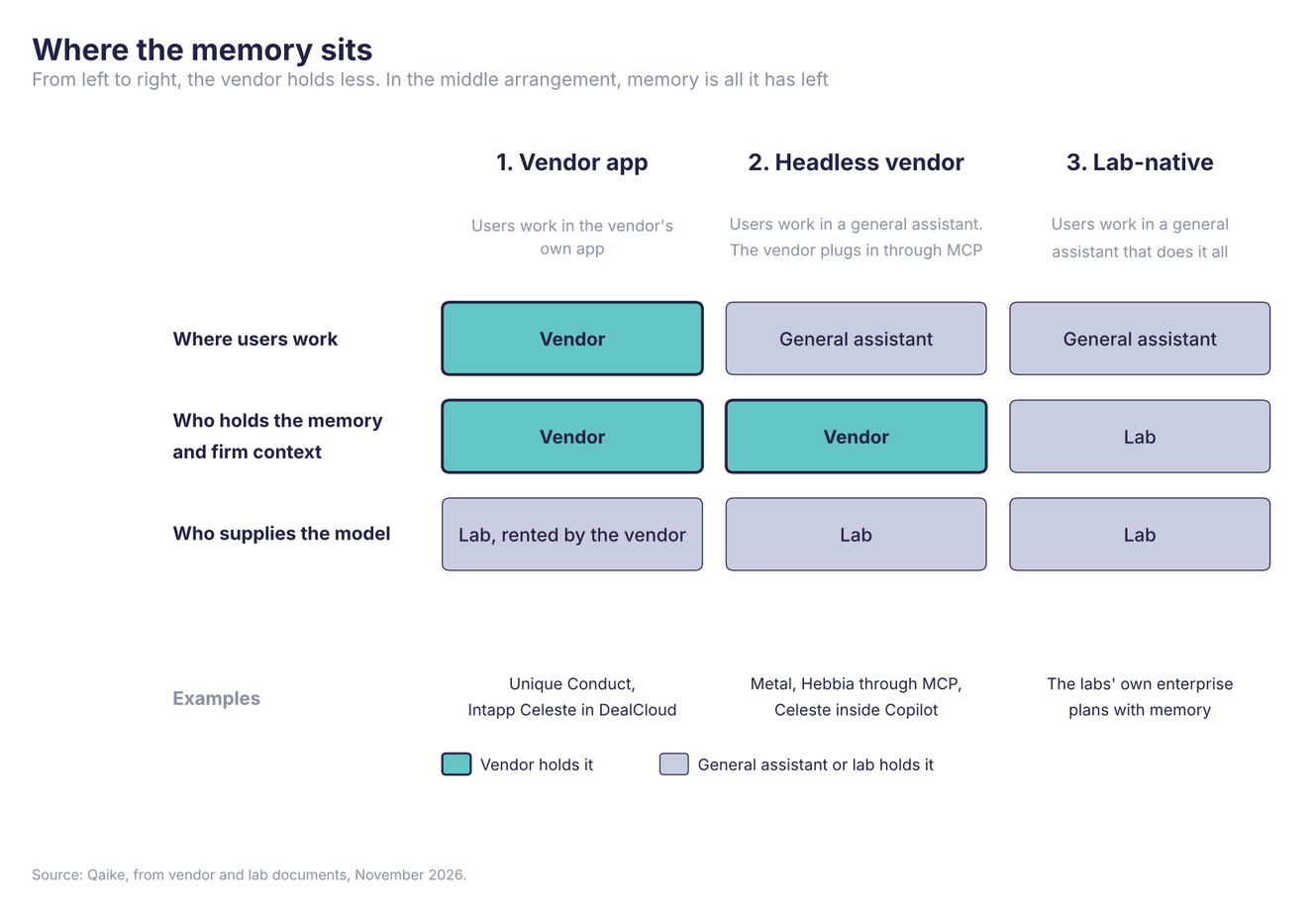
Grid of three arrangements, vendor app, headless vendor and lab-native, showing who holds the screen, the memory and the model

Figure 3: Where the memory sits. Source: Qaike, from vendor and lab documents, November 2026.

The middle arrangement is the bet several vendors now make. It works for them only if the memory layer stays with the vendor when the screen moves to the lab’s assistant. That is the layer to watch.

Questions for buyers, and what we found

Kind of memoryAsk the vendorWhat we found
UserCan each user see, edit and delete it? Does switching it off delete it?Unique users view and edit their profile, but switching it off keeps the file. Hebbia users create, review and delete what Max, Hebbia’s assistant, keeps. Claude users can view, edit and export theirs. Intapp and Metal: not disclosed
Client and dealWhere is it stored? Who can read it? How are errors corrected, and is the correction logged?Unique keeps it in a sandbox for each tenant, with an audit log. Intapp keeps it in DealCloud under the firm’s own permissions. Metal keeps every conflicting value, ranks them and shows the ones it set aside. Hebbia: its graph enforces access on every entity and relationship and keeps every version with its effective date. It also connects to Salesforce, bringing pipeline and client activity into Chat, though nothing says it keeps that history as memory. Storage location: not stated. How corrections are logged: not disclosed
Firm knowledgeWho builds and maintains it, us or you? Can we export it with its sources in a standard format?Intapp: the firm builds the ontologies. Hebbia: its own experts tailor each graph, and every link keeps its source. Metal builds the graph from the firm’s files. Unique: Conduct builds a living memory of the firm’s knowledge, but who builds it and how it is structured is not stated. Export: only Metal states one, a full export of everything a firm builds within 30 days, with no format given
ProceduralAre skills in an open format? Can we move them to another tool?Hebbia imports skills from other platforms. Unique skills can be admin-managed or user-created. Intapp: playbooks live in Celeste and outlast any individual LLM, but only in limited availability. Metal: recurring work runs as Workflows, each result written back to the graph, and teams can build their own skills. Export of skills in their own format: no vendor states it
All kindsIs memory priced separately? What happens to it if we leave? Can we see which memory shaped an answer?We found no separate prices (see below). Exit terms are not public. Hebbia and Metal cite the source behind each answer, which is not the same as showing which memory shaped it. Unique and Intapp: not disclosed

The gaps are the point. On export, only Metal states a commitment, and on exit terms every vendor is silent, so funds should get answers in writing before they sign.

One finding on price: we found no separate charge for memory at any vendor we reviewed. It comes bundled into the AI layer or the platform licence. Intapp’s DealCloud, for example, is a CRM, and Celeste, the AI layer added to it, runs under a fair use policy with no billing by consumption. That policy covers AI usage in general, not memory alone.

Our view: the buyer pays for memory mainly through the cost of leaving.

What to watch next

  • Export terms. Only Metal states an export today, and it gives no format. The first vendor to offer a clean export of firm memory in a standard format will force the others to answer.
  • The labs’ enterprise memory. If shared, firm-wide memory becomes common in general assistants, the third arrangement in Figure 3 turns into a serious alternative to a vendor’s own layer.
  • Independent tests. Hebbia’s 80% and Metal’s 95.1 are vendor figures. Neither has been checked by a third party.
  • Regulators. A stored client memory is a record. Expect questions on retention, correction and deletion.


To compare vendors by what they hold and where it sits, see the Qaike vendor directory.

This article is based on publicly available information and reflects Qaike’s own analysis and opinions. It is not intended to provide professional advice, endorsement, or a definitive assessment of any vendor or product. While every effort has been made to ensure accuracy, completeness and correctness cannot be guaranteed.

Created by Qaike – Powered by AI.

Post feedback
Was this helpful?